

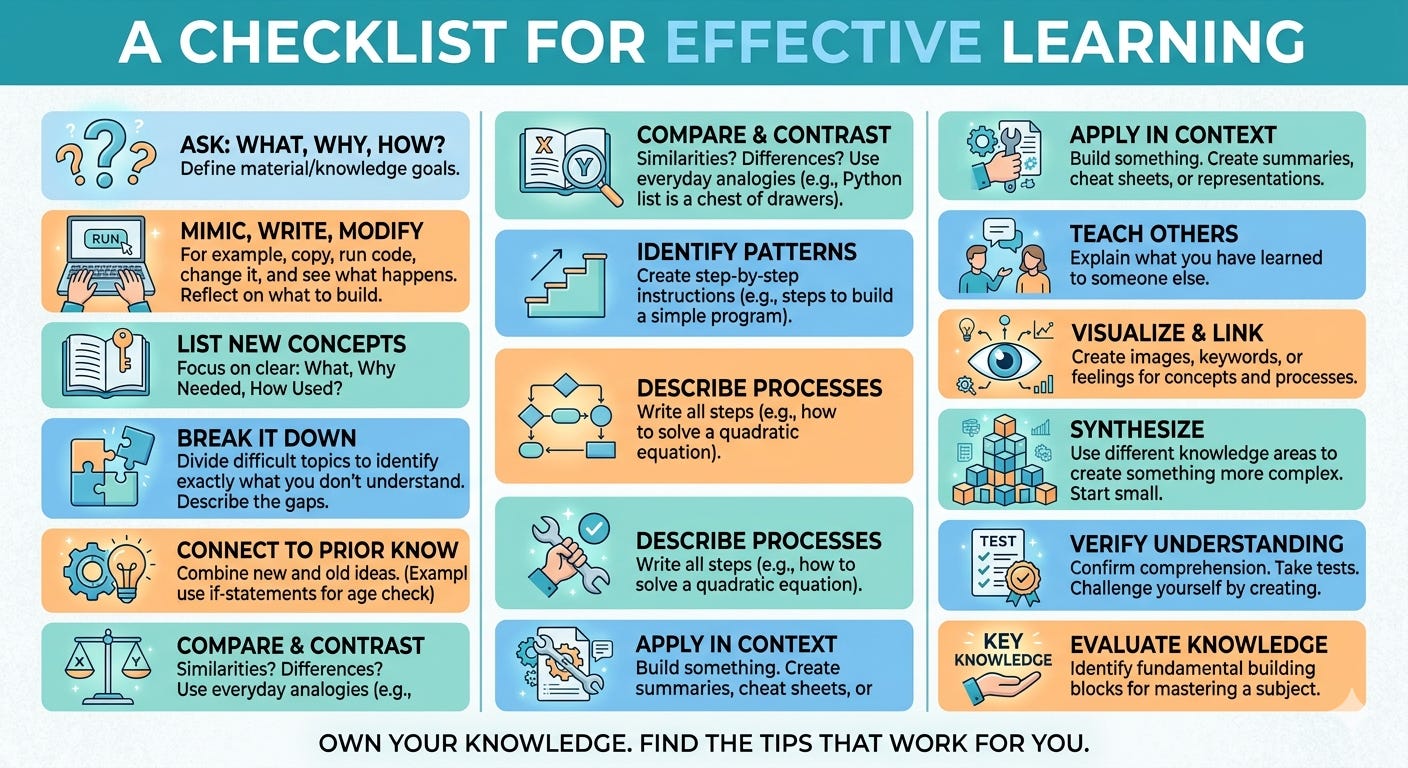
Effective learning requires you to adapt knowledge until it becomes your own; you must own the knowledge. You shape it to fit who you are as a person!
In the list below, I have listed some tips to help you achieve this (find the ones that work best for you):
Ask the core questions: What, why, and how am I supposed to learn this material/knowledge?
Mimic and transcribe: During the learning process, copy or write things down to get a feel for how they work. For example, copy a block of code and run it. Then, modify it and see what happens. Reflect on what you want to build next, find more information, and test it. This makes you a more active learner.
List new concepts/terms: Identify words you don’t yet understand. Make it your goal to achieve mental clarity regarding what they are, why they are needed, and how they are used.
Break it down: Does the subject feel too difficult? Break it into smaller parts until you find pieces you understand. This makes it easier to identify the specific parts you don’t understand. Your goal is to clarify exactly where the gap in your knowledge lies.
Being able to describe exactly what you don’t understand is a major win. Use that clarity along with these tips and other resources to succeed!
Connect to prior knowledge: Combine new information with what you already know. For example in programming, use
if-statementstogether with variables and user input to determine if a person is of legal age.Compare and contrast: Look for similarities and differences. For instance: what is the difference between an algebraic expression and an equation? Are there similarities? You can also create analogies to everyday objects.
Example: What is a “list” in Python? A list stores data/information in a sequence. What is that like? Imagine a chest of drawers (the list) where you put items. There are different drawers for socks, pants, and shirts (our data).
Identify patterns: Can you see patterns in what you are learning? Create step-by-step instructions for yourself.
Example in programming: What are the steps involved in creating a program that continuously asks a user for a number?
Describe processes: Can you create and describe a process for what you’ve learned? For example, write down all the steps required to solve a quadratic equation.
Apply knowledge in context: Use what you’ve learned to create something. Create a compressed representation (a summary or cheat sheet) of the material.
Summarize: Make short summaries of what you have learned.
Teach others: Explain the concepts you have learned to another person.
Visualize: Create an image, a keyword, or a “feeling” that helps you extract what you’ve learned. Create these for new concepts and processes, then link them together. Use visualization to connect important knowledge that you have already compressed.
Synthesize: Use different areas of knowledge together to create something larger. Start small and simple, then let it grow into something more complex.
Verify understanding: Find ways to confirm you’ve actually got it. Take tests. Challenge your knowledge by building and creating!
Evaluate the knowledge: Identify the information that is fundamental to mastering the subject. Fundamental knowledge is usually the building block for more complex topics.
Learning is an activity that you engage in. You need to actively work with the material that you want to learn. The best tip to summarize all the points above is:
You have learned something when you can use it to create and express what is in your mind!
What do you think about my list? Please leave a comment or restack the article to help me grow this publication.
I am most certain you used some of the points above in order to learn.
If you find the list helpful please consider subscribing for more content on making learning more easy and engaging.